
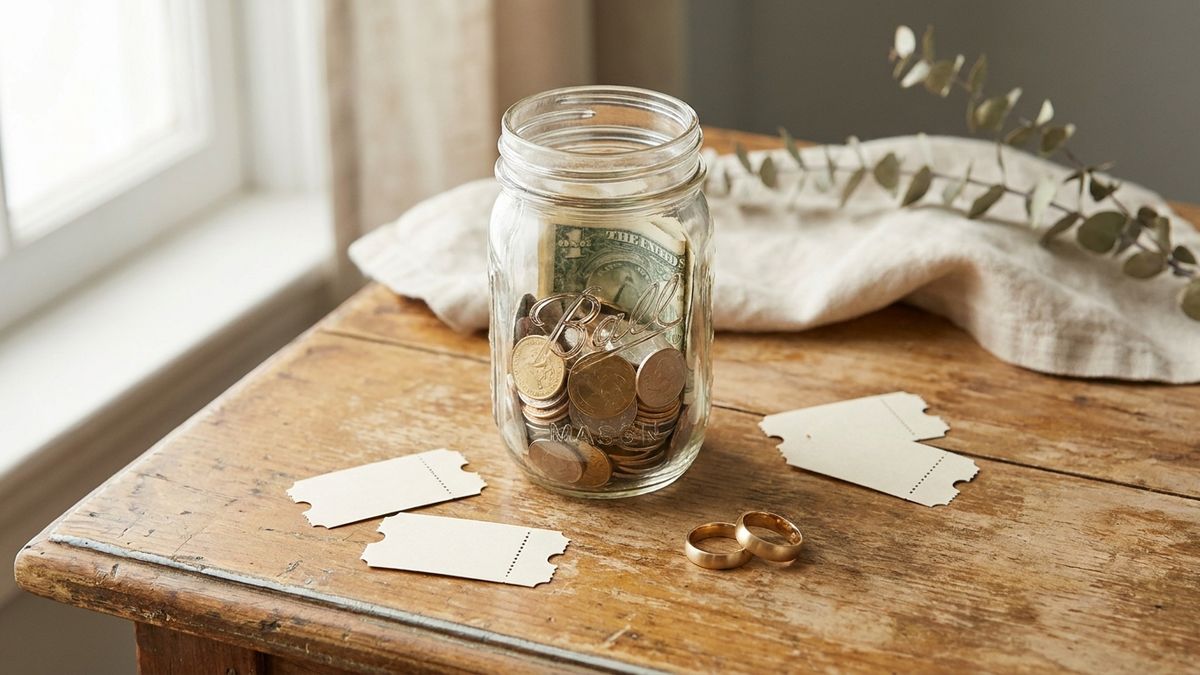
I've stood at the door of a stag and doe with a metal cash box, making change for a twenty while someone's uncle explained the toonie toss to me for the third time. My cousin's was in the basement of a Legion hall — a booklet of raffle tickets, a table of gift baskets, a Texas mickey wrapped in ribbon waiting for someone's toonie to land closest without touching it. It ran until one in the morning and raised a genuinely impressive amount of money. It also took four people two months to plan, and by the end of the night half the wedding party was too tired to enjoy their own event.
Chris and I never threw one. Partly because our friend group is scattered across three provinces, and a hall full of raffle tickets doesn't work over a group chat. Partly because I didn't want anyone's night out doubling as a fundraiser they hadn't signed up for. If you're on the fence about booking the hall, here are six other ways to raise money for a wedding — starting with the one we built ourselves, and five more that people I actually know have pulled off.
A wedding prediction pool
We used ours during the wedding weekend itself instead of before it — guests paid a few dollars to guess things like who'd cry first and how long the speeches would run, and whoever guessed closest split the pot. I've written about how that whole weekend went, but the short version for fundraising purposes is this: nobody bought a fifteen-dollar ticket to a hall they had to drive to. They filled out a sheet on their phone during a night they were already at, and more than one winner handed the payout straight back to us instead of keeping it.
It won't replace a stag and doe's reach into a big local guest list of aunts and coworkers who'd never otherwise hand you cash directly — it raises less, and it raises it more quietly. But it costs nothing to set up, nobody has to book a hall or staff a door for three hours, and it works even when your guest list is scattered across three provinces. That gap, between needing an entire additional event and something guests just do during a night you're already having, is why Chris eventually turned it into Wedding Parlay — you write the questions, guests answer from their phones, and the leaderboard scores itself instead of someone adding up a paper sheet at one in the morning.
A skills swap instead of a bar tab
A stag and doe makes its money by running a bar and charging admission at the door. My friend Priya skipped both and ran a skills swap instead: everyone in her fiancé's friend group who had a trade or a hobby worth money — a guy who does small engine repairs, a woman who does gel manicures out of her kitchen, a friend who bakes wedding-quality cakes on the side — offered a set number of appointments in the two months before the wedding, priced like a menu, with the money going to the wedding fund instead of their own pocket. No hall, no bar to stock, no door to staff. Just a shared spreadsheet and people paying for services they were going to book anyway.
Selling the engagement clutter
Between registry duplicates, the extra folding chairs someone talked you into buying for a backyard ceremony, and the decor you tested once and never used again, most engagements generate a small pile of stuff worth real money. One couple I know timed a joint yard sale for the Saturday before their wedding and told everyone exactly what it was for. Half the 'customers' who showed up were guests who came to overpay for a stack of mason jars on purpose. It won't fund a honeymoon on its own, but it's the easiest thing on this list to actually pull off in a single weekend.
A pledge challenge tied to something you're already doing
If one of you is already training for something — a half marathon, a hundred-kilometre bike ride, even just cutting sugar for the three months before the dress fitting — you can turn it into a pledge drive instead of a separate event. Guests sponsor a dollar amount per kilometre, per pound, per sober weekend, the same way a charity fun run works, except the payout is a wedding fund instead of a cause. Nobody has to do anything extra. You're just putting a price on something that was already going to happen.
Folding a small raffle into a party you're already throwing
You don't need an entire ticketed night to run a raffle. If you're already hosting an engagement barbecue, a housewarming, or a joint birthday with your future spouse, fold a basket or a 50/50 into it. It raises less than a dedicated stag and doe would, but it also costs almost nothing to run: no hall rental, no separate guest list, no night off work for the wedding party to staff a door. A friend of ours cleared close to six hundred dollars for a honeymoon fund off one raffle basket at a barbecue nobody had to buy a ticket to attend.
A wishing well with actual prices on it
"Contribute to our honeymoon fund" is vague enough that most guests default to whatever a card usually holds. Naming the actual things — forty dollars covers the DJ for an hour, twenty-five covers the late-night pizza, a hundred and fifty covers the getaway car — gives people something specific to buy instead of a number to guess at. It's the same reason our prediction pool worked better than a plain tip jar would have. A guest who knows exactly what their money is buying tends to give more than one asked to fund something abstract.
None of these need to stand alone. The couples I know who raised the most money didn't throw one big event and call it done — they stacked two or three smaller ones across the run-up to the wedding instead. We leaned on the prediction pool because it fit the kind of wedding we were having; yours might be a skills swap and a priced wishing well, or a raffle folded into a barbecue you were already planning. Start yours if a prediction pool sounds like it fits your weekend, or read how a full wedding prediction pool works for the longer version of ours.
Frequently asked questions
Do people still throw stag and does?
Yes, especially in Ontario and Manitoba, where the tradition is strongest. They still raise real money for couples with a big local guest list and enough people willing to volunteer at the door. They're just not the only option anymore, especially once your guests are spread across cities.
How much money do these alternatives actually raise compared to a stag and doe?
Less, usually, if you're only doing one. A well-run stag and doe with fifty ticket sales and a stacked raffle table can clear a couple thousand dollars in a single night. A prediction pool or a priced wishing well raises less per event, but costs nothing to run and doesn't need anyone to book a hall, so a few smaller ones can add up without the two months of planning.
Can I combine a stag and doe with one of these instead of picking just one?
Plenty of people do. A raffle or a prediction pool works fine as an addition to a stag and doe you're already planning, or as the smaller-scale version if you decide the hall and the door staffing aren't worth it this time around.